
Showing posts with label G: specific. Show all posts
Showing posts with label G: specific. Show all posts
No Reservations: “Into the Fire”
Few competitions are contested as fiercely as the hyper-competitive restaurant business in New York City. Although one wouldn’t immediately consider the kitchen as a segment of THE GAME, the leadership, logistics, attention to details, and teamwork necessary to build and sustain success in the restaurant business (especially in NYC) are identical to any elite team or organization realizing and maintaining success in any endeavor in THE GAME.
In the following video, after eight years away from the daily grind of Brasserie Les Halles‘ kitchen, Tony Bourdain returns for a double shift on the line in an engaging and amusing episode of No Reservations; revealing the inner workings and controlled chaos of a frenetic NYC restaurant.
Here’s part 1:

The Top 10 of “ESPN’s Top 50 Players of the 2010 World Cup” and Their Roles in THE GAME
ESPN.com released its Top 50 Players of the 2010 World Cup yesterday and there were no surprises. While reading the players synopses and scouting reports we thought about how these players’ skills could be utilized in THE GAME and how new nodes could be built around their talents.
Transcribing ESPN.com’s rankings and comments, our analyses of the Top 10 football players in this year’s World Cup and their proposed roles in THE GAME can be found in red font.
1. Lionel Messi
Country: Argentina
Club Team: Barcelona
Position: Forward
Age: 22


NATIONAL TEAM: 41 appearances, 13 goals
WORLD CUP 2006: 3 app, 1 goal
Lionel Messi is the best pound-for-pound soccer player in the world, and perhaps of all time. At 22, Messi has won just about everything there is to win, both individually and in club soccer. Missing is any sort of hardware with Argentina, aside from an Olympic gold medal. Messi's game relies on its unpredictability and magnificent control of the ball, which seldom demurs to anything Messi asks it to do. Listed at a charitable 5-foot-7, he's even a good header. While transcendent with his club, Barcelona, in the last few years (his 17 goals this season are tied for the most in Spain), the knock on Messi has been that he doesn't match that dominance for Argentina. For the most part, this is blamed on Argentina manager Diego Maradona's refusal to deploy him in his natural position -- on the right, allowing him to cut in -- and posting him behind a deep striker instead. Maradona, one of the best of all time as a player, has named Messi his successor as Argentina's soccer savior, a label that has proved disastrous for all others so designated previously by Maradona.
Scouting thumbnail: Technical genius with a low center of gravity and pace who can break down any defense off the dribble and conjure something out of nothing (similar to a basketball point guard or B who, if eligible to do so, has the option of ball distribution responsibilities when he has broken into the second level of the defense). Struggles when used as a striker and prefers playing out wide and cutting in on his left foot (Messi would be best suited on the wide right wing as a SC/TWB and/or a transition player who can blend into another node that requires his skill set; such as a football forward on the right wing passing off to or transitioning into a QB/SC, the main signal caller and ball distributer for wing modules).
2. Cristiano Ronaldo
Country: Portugal
Club Team: Real Madrid
Position: Midfielder
Age: 25


NATIONAL TEAM: 68 appearances, 22 goals
WORLD CUP 2006: 6 app, 1 goal
"Buy that kid," Manchester United players told manager Alex Ferguson after an 18-year old Cristiano Ronaldo dos Santos Aveiro, whose middle name allegedly honors Ronald Reagan, had torched Man U in a friendly in the summer of 2003. Ferguson obliged his players' wishes, shelling out some $20 million and handing Ronaldo the No. 7 jersey, previously worn by legends George Best, Bryan Robson, Eric Cantona and David Beckham. Ronaldo responded by outdoing all of the aforementioned in a six-year romp during which he scored 118 goals and won three Premier League titles, one Champions League and one Club World Cup, swiping 42 individual prizes, including the 2008 FIFA World Footballer of the Year, along the way. Last summer, Ferguson sold him to Real Madrid for a record $132 million. Ronaldo has become a lethal dribbler, superlative header and long-distance shooter and one of the better free-kick takers on the planet and will anchor an aging Portugal looking to shine one last time.
Scouting thumbnail: Explosive, pacy and an astonishingly prolific goal scorer for a winger (with his speed and explosiveness, Ronaldo would be a nice fit on the wings as a football attacker and/or the main playmaker in a wing module). Specializes in long-range free kicks and shows the ability to shoot from anywhere (Ronaldo’s strong accurate leg could also be utilized for long internodal passes in transition zones).
3. Wayne Rooney
Country: England
Club Team: Manchester United
Position: Forward
Age: 24


NATIONAL TEAM: 57 appearances, 25 goals
WORLD CUP 2006: 4 app, 0 goals
When Wayne Rooney broke through internationally at just 17 years of age and took his place next to then-England striker Michael Owen, a British journalist referred to them as "the baby-faced assassin and the assassin-faced baby," with Rooney accounting for the less flattering of the descriptions. An England side without him has become unimaginable, as the Liverpool-born Rooney developed into a world-class striker in a country starved for them. The highly athletic Rooney has reinvented his position, swerving all over the attacking half of the field to drop back into midfield when needed or provide the final tap on a goal. With former teammate Cristiano Ronaldo now in Spain, Rooney has carried the scoring load for Man U, leading the Premier League with 23 goals. Rooney sports a tattoo that says, "Just Enough Education To Perform." While this may be generous, his on-field intelligence is off the charts. One half of another British power couple, Rooney and his wife Colleen have taken England by storm, he as a soccer player and she as a fitness guru/fashion commentator of some sort.
Scouting thumbnail: Complete striker who can play anywhere across the front three (Rooney’s power and playmaking ability are best suited for any node or transition module that requires an aggressive power forward in an attacking style of offense). Powerful build and aggressive attitude poses problems for any defense. Can score any type of goal and has improved his finishing skills.
Country: Brazil
Club Team: Real Madrid
Position: Midfielder
Age: 27


NATIONAL TEAM: 73 appearances, 26 goals
WORLD CUP 2002, 2006: 6 app, 1 goal
Kaka belongs to Jesus. The T-shirts he has shown underneath his jersey say so. An oxymoronic principled soccer player, Kaka also happens to be the rare Brazilian star who comes from an upper-middle-class background. Money couldn't tear him away from Milan and its fans. Kaka said he wasn't interested in the heaps of money offered him by Manchester City and Real Madrid. So long as Milan would have him, he would be staying. Milan needed his transfer fee to stay afloat though, so after Kaka won everything there is to win for club and self, Milan sold him to Real Madrid for about $95 million in June. So now Kaka also belongs to Real Madrid. Kaka has become a central figure in manager Dunga's new Brazil, masterminding its lethal counterattacks, which have made a Brazil team not as deep in world-class players as in past years still one of the world's best.
Scouting thumbnail: Knee injuries have sapped some of his speed and he no longer goes on galloping dribbles the entire length of the field. Artistic playmaker who can break down defenses via dribble or pass (Kaka’s ability to dribble across large portions of the field makes him a nice fit for positions that serve as transitional conduits into node positions that have a similar esthetic: basketball point guard, forechecking hockey defenseman/forward, American football kick/punt returner who regularly distributes or laterals the ball to teammates during the return).
Country: Spain
Club Team: Barcelona
Position: Midfielder
Age: 30


NATIONAL TEAM: 83 appearances, 8 goals
WORLD CUP 2002, 2006: 7 app, 0 goals
Every soccer team needs a Xavi, a savvy midfielder whose organizational skills are the glue that held both Barcelona and Spain together in their respective runs to glory. Along with Andres Iniesta he makes up the superb engine room for club and country, connecting the dots between those around him with his infallible short passes. The natural successor to Pep Guardiola, now Barcelona's manager, Xavi has been a mainstay in Barcelona's lineup since 1998 after joining the club's academy in 1991. With a contract running through 2014, he isn't liable to be leaving the only employer he has ever had anytime soon. His Player of the Tournament award for Spain's EURO 2008 triumph was justified. Perhaps the best illustration of the force that is Xavi was his performance against archrivals Real Madrid in May 2009, when he notched four assists in a 6-2 Barcelona win.
Scouting thumbnail: Intelligent playmaker who combines precise passes and artistic vision in both the final third and from a deep lying position. The pulse of the Spanish team. Superb ability to keep the ball (ideal SC).
Country: Ivory Coast
Club Team: Chelsea
Position: Forward
Age: 31


NATIONAL TEAM: 65 appearances, 43 goals
WORLD CUP 2006: 2 app, 1 goal
When Chelsea splashed out $37 million for him in 2004, Didier Drogba seemingly came out of nowhere, uncommonly late in arriving on the world scene at 26. Now 31, he nonetheless has become one of the world's foremost strikers, and probably the most athletic one. Both captain and all-time leading scorer of Ivory Coast, he will be relied upon to debunk the stereotype that for all their ability, African teams never perform. This robust striker both takes up and covers a lot of real estate, often requiring several opposing defenders to keep him in check -- although Premier League opponents haven't been too successful at that this season, as Drogba ranks second to Wayne Rooney with 19 goals. Known for his big personality and intense looks, Drogba is spectacular to the eye.
Scouting thumbnail: Talismanic striker and physical specimen whose power makes him practically unplayable when he puts his mind to it. Can score all types of goals and excels as a lone front man (Drogba is best suited as a scoring center forward in nodes that utilize formations that place him on the frontlines; either directly behind, in front of, or within the line).
Country: Spain
Club Team: Barcelona
Position: Midfielder
Age: 25

NATIONAL TEAM: 39 appearances, 6 goals
WORLD CUP 2006: 1 app, 0 goals
There's a reason they call him "El Illusionista" -- "The Illusionist." Andres Iniesta is a whimsical playmaker who transcends position and role to create a steady flow of chances for whoever is lucky enough to be playing in front of him. So multifunctional as to be capable of slotting into just about any midfield or attacking job, Iniesta is the creative counterpart to Xavi's pragmatism in Barcelona's and Spain's golden tandem. Coming up as Ronaldinho's understudy, Catalunya and all of Spain now shudder at the thought of life without Iniesta. Luckily, lithe as he may be, he has an uncanny ability to play through injury.
Scouting thumbnail: Small, technical playmaker with low center of gravity and tremendous ball control and creative vision, regarded by some peers as the best player in the world. Very difficult to dispossess and can also run at defenders and take them off the dribble. Sometimes overpasses when he should take the shot himself (Iniesta would be an ideal SC in a centrally positioned module that takes advantage of his vision and playmaking ability).
8. Fernando Torres
Country: Spain
Club Team: Liverpool
Position: Forward
Age: 25

NATIONAL TEAM: 71 appearances, 23 goals
WORLD CUP 2006: 4 app, 3 goals
Fernando Torres was born to score goals. He was converted from a goalkeeper to a striker at age 7 and scored 55 goals as a 10-year-old, which caught the attention of his beloved Atlético Madrid, which had relaunched its academy after disbanding it a few years earlier (sending superstar Raul into the arms of Real Madrid). The club wouldn't make that mistake a second time. Torres broke into Atlético's starting lineup at 17 and never did stop scoring goals, earning him a transfer to Liverpool in 2007. At 25, Torres, the embodiment of the modern striker, already has 132 competitive league goals under his belt.
Scouting thumbnail: Well-rounded, pacy striker with tremendous technique who draws much support as the best in the world. Likes to play off the shoulder of the last defender and can finish with aplomb with either foot and is also superb in the air. Can sometimes be thrown off his game if defenders dish out the rough treatment and the referees are lax in calling fouls. Similar to Didier Drogba, Torres fits best in an offense that uses a scoring center forward in nodes that utilize smaller speed formation modules and places him directly behind or on the frontline.
Country: England
Club Team: Liverpool
Position: Midfielder
Age: 29

NATIONAL TEAM: 77 appearances, 16 goals
WORLD CUP 2006: 5 app, 2 goals
Dismissed as too slight for professional soccer as a child, Gerrard went on to be voted the second-best Liverpool player of all time by the club's fans and is even a Member of the Order of the British Empire. Several clubs passed on him when he was in his teens, before his hometown Liverpool finally committed to him. Regret it they did not, as Gerrard emerged as a superb attacking midfielder, who also operates as a second striker or as a winger. Gerrard is a nine-year veteran of England, pairing with Frank Lampard to form the best duo of attacking midfielders in the world.
Scouting thumbnail: Complete player who can play virtually anywhere on the field, but excels at club level with his own unique English interpretation of the trequartista role. Combines an explosive long-range shot with aggressive tackling, but struggles at times to shed man markers. As an aggressive defender and attacking midfielder, Gerrard would excel at multiple positions in the defense-offense transition formation module (behind the frontline or as a forward on either wing).
Country: Ghana
Club Team: Chelsea
Position: Midfielder
Age: 27


NATIONAL TEAM: 74 appearances, 10 goals
WORLD CUP 2006: 3 app, 0 goals
An elite defensive midfielder who doesn't shy away from attacking, Ghana's Michael Essien is one of Africa's finest. With the help of fellow midfielders Sulley Muntari and Stephen Appiah, Essien led Ghana to the second round in Germany in 2006. Beating the Czech Republic 2-0 and the U.S. 2-1, Ghana's surprise run made it the only African country to survive the group stage. Essien, a two-time African Player of the Year, now has four more seasons as a regular at Chelsea under his belt. His versatility, energy and defensive pedigree make him one of the most consistent and reliable players in the world. Out since mid-January with a knee injury, Essien is expected to return by the World Cup but will need to prove he's fit.
Scouting thumbnail: The world's most dominant defensive midfielder. Covers an incredible amount of territory with boundless energy and the ability to contribute box to box. Possesses a powerful long-range shot. A lockdown defender with a powerful shot, Essien would excel as a defenseman in the defense-offense transition module; behind the line or in defensive modules that utilize a roaming defender behind a first line of defense.
See the rest of the ESPN.com Top 50 Players of the World Cup here.

THE GAME In Pictures (…Actually Videos): Celebrity Apprentice 3
Here’s a little video follow-up to our last post.
The men’s (Rock Solid) and women’s teams (Tenacity) were taping episodes for Celebrity Apprentice this past fall. One of the tasks, sponsored by Kodak, involved inviting New Yorkers into the Kodak Store to take pictures with their favorite stars. Here is some third party footage of that taping:
Team Rock Solid…

Team Tenacity…

THE GAME: Mergers and Partnerships in College Football
The recent struggles of Michigan and Notre Dame’s football programs prompted Wall Street Journal writer Jason Gay to recently suggest (jokingly) a merger of the two programs as an instant solution for elevating the two programs back to national prominence.
After I read Gay’s article, I remember seeing the following highlight from earlier this NFL season of Miami Dolphins teammates quarterback Chad Henne (from the University of Michigan) throwing a 50 yard touchdown pass to wide receiver Ted Ginn, Jr. (from Ohio State University)…
…and I started to think about different recommendations and guidelines that could be used to merge teams (and the reasons to merge them in the first place), specifically in college football, and THE GAME in general. Here are the notes:
1. Inter-conference matchups. Using men’s college basketball’s early season SEC/Big East Invitational and the ACC-Big Ten Challenge inter-conference matchups as a model, two or more teams from the same conference can temporarily merge to face another set of teams from another conference. These types of matchups can serve several purposes:
- since the college football season does not include preseason tune-up games like in the NFL, inter-conference matchups allow teams to play in an actual game without extending their players for an entire game.
- during the initial rollout of these types of games, wins and losses would not count towards a team’s record for a given season. However, these matchups would help determine a conference’s relative strength, which in turn could help a team’s national ranking (if said team is in a relatively stronger conference) as the season progresses.
2. “Tag-Team” football—a newly created node. If NCAA bylaws could be modified regarding the status of red- and gray-shirt athletes, college football programs could merge their red- and gray-shirt players with other colleges’ red and gray shirts players and play an entire season against similarly constructed teams in an independent “tag-team” football league (e.g. the Pioneer Football League). By merging programs, the constituent programs can essentially share the cost of running a player development program (yes, this could further thin the blurry line that already exists between the amateur student athlete from the professional athlete). Mergers of programs could either be aligned through conference affiliations or independently (an ideal arrangement could be a university from a major conference partnering with a university from a mid-major conference to go up against institutions that have similar relationships).
3. Teams will want to merge with other teams that share similar offensive and/or defensive philosophies and approaches (if they are involved in matchups as explained in 1. and 2. above). This will help maintain consistency in player development. Players who are committed to college football programs that run a certain offensive scheme (for example, a spread option attack) or defensive scheme (3-4 vs. 4-3) will be teamed with players from other programs that run the same type of offense.
4. Preserve traditional rivalries by avoid pairing teams who are bitter rivals. So one would never see the following teams merge: Michigan-Ohio State, Alabama-Auburn, USC-UCLA, West Virginia-Pitt, Texas-Texas A&M, Army-Navy, etc..
5. The rules and guidelines discussed here could be applied and modified to the NCAA’s Divisions I (Football Championship Subdivision), II and III, the NAIA and the NJCAA.
6. Coordinating a joint program from schools that are in different geographic locations would be challenging but not impossible. Incorporating a modular approach to offense and defense would likely be the best method of merging teams together that are geographically separated. Each team that makes up the bigger team would have all the positions within a module practice together to build cohesion within that module. So by having wide receivers, running backs and quarterbacks practice as one module, offensive linemen and running backs practice as another module, safeties and cornerbacks practice as another module, etc., a merged team could, with minimal practice time together in a shared physical location, establish and maintain a high degree of play while simultaneously preserving the merged team’s ability to mix up plays and packages.
Technologies such as videoconferencing joint team meetings and collaborative internet applications for coaches and players could also help merged teams bridge the geographic gap as well.
7. Composition of the coaching staff of the merged program. With the time constraints involved in coaching college football (including coaching, recruiting, alumni relations, etc.) the composite staff of merged teams would likely consist of a staff hired by the merged universities with a prearranged agreement as to how many coaches each university would supply to the endeavor. Those who are interested in pursuing coaching at the college level could eventually utilize opportunities provided by these partner universities as a way to begin their journey “up the coaching ladder”.
8. Uniforms and school colors. There could be plenty of variation here depending on the degree of integration. Some ventures may choose to have completely new composite home and away uniforms created to reflect both institutions. For the sake of tradition, other universities may choose to keep their respective helmets the same and create new uniforms to reflect the merger. And others may decide to keep their traditional uniforms intact; varying only the home or road colors with their partner university. A lot of different combinations are possible.
9. Occasionally sprinkle in some inter-regional “superpower matchups”. Texas & Alabama vs. Notre Dame & Ohio State quickly comes to mind as a North-South power matchup that features big names while avoiding the merger of traditional rivals.
What other recommendations and guidelines can you think of? We’d like to hear your ideas. You can comment here or go to THE IdeaBOARD >> to explain and discuss your ideas.
THE GAME: THE GAME 2009
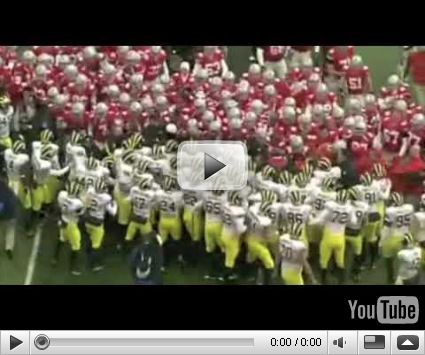
This is the week of the Michigan-Ohio State game.
Rated by ESPN in 2000 as the greatest sports rivalry in North America, there is perhaps no other rivalry in college sports that shares such a dysfunctional symbiosis. Characterized by fans who despise the other program while simultaneously maintaining a respect for their rival and the rich history of the conflict, this Saturday’s game in Ann Arbor will be the 106th meeting.
Some pregame hype ensues:



GO BLUE!
Taking The “Foot” Out of Football

An interesting video from ESPN about contrarian Kevin Kelley, head coach of the Pulaski Academy Bruins in Little Rock, Arkansas. Kelley’s team never punts or kicks field goals. Kelley believes that from a statistical perspective, it is more favorable to “go for it” than to kick it. Interestingly enough, Kelley’s teams have won two of the last seven state championships.
G Level: Glory >> Notre Dame vs. USC
This past weekend, USC barely held on for a thrilling win over Notre Dame, 34-27.

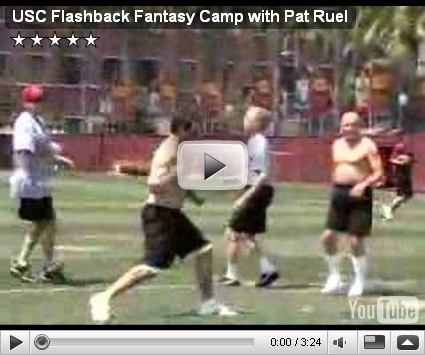
In my previous post, I touched on the subject of GAME Levels and one level in particular: the “glory” level. In that post, I showed a clip from the 2008 USC Flashback Fantasy Camp where those in Trojan Nation (typically middle-aged or thereabouts) get the opportunity to be coached by the USC coaching staff.
Without further ado, I present to you the incoming USC Trojans Flashback Class of 2008:

…and now the incoming Notre Dame Fighting Irish Fantasy Camp Class of 2008:

Notre Dame is currently listed as a 24 point favorite in the glory matchup.
GAME Type: Specific / GAME Level: Glory / Entertainment Value: DEFCON 1
In an earlier post, I discussed the various GAME Types and Levels that can exist in THE GAME. In an attempt to illustrate one of the many combinations that can exist, I present the following for your viewing pleasure:
GAME Type: specific (football)
GAME Level: glory
USC Trojans Flashback Fantasy Camp 2008
Blended Nodes: International Rules Football
Portions courtesy of Wikipedia

International rules football, a blended node consisting of Australian rules football and Gaelic football, was created to facilitate international representative matches between Australian rules football players and Gaelic football players. International rules football is one of the few team sports without any dedicated clubs or leagues and is usually contested by men’s, women’s and junior teams in tournaments and test matches.
A brief overview of International rules football rules as explained by Wikipedia:
“The rules are designed to provide a compromise between those of the two codes, with Gaelic football players being advantaged by the use of a round ball and a rectangular field (Australian rules uses an oval ball and field), while the Australian rules football players benefit from the opportunity to tackle between the shoulders and thighs, something banned in Gaelic football. The game also introduces the concept of the mark, from Australian rules football, with a free kick awarded for any ball caught from a kick of over 15 meters.
A player must bounce, solo or touch the ball on the ground once every 10 meters or six steps. A maximum of two bounces per possession are allowed, while players can solo the ball as often as they wish on a possession. Unlike in Gaelic football, the ball may be lifted directly off the ground, without putting a foot underneath it first. Players however cannot scoop the ball off the ground to a team-mate, nor pick up the ball if they are on their knees or on the ground. If a foul is committed, a free kick will be awarded, referees can give the fouled player advantage to play on at their discretion.
The game uses two large posts and two small posts, as in Australian rules, and a crossbar and goal net as in Gaelic football.
Points are scored as follows:
- In the goal net (a goal): 6 points, umpire waves green flag and raises both index fingers.
- Over the crossbar and between the two large posts (an over): 3 points, umpire waves red flag and raises one arm above his head.
- Between a large post and a small post (a behind): 1 point, umpire waves white flag and raises one index finger.
Scores are written so as to clarify how many of each type of score were made as well as, like Australian football, giving the total points score for each team; for example, if a team scores one goal, four overs and 10 behinds, the score is written as 1-4-10 (28), meaning one goal (six points) plus 4 overs (4 × 3 = 12 points) plus 10 behinds (10 × 1 = 10 points), for a total score of 28 points.
An international rules match lasts for 72 minutes (divided into four quarters of 18 minutes each). Inter-county Gaelic football matches go on for 70 minutes, divided into two halves, and Australian rules matches consists of four 20 minutes quarters of game time, although with the addition of stoppage time, most quarters actually last between 25 and 30 minutes.
As in Gaelic football, teams consist of fifteen players, including a goalkeeper, whereas eighteen are used in Australian rules (with no keeper).”
Rich Rodriguez Discusses The Spread Option Offense
Portions courtesy of Wikipedia
Updated Videos of Coach Rod. Some new old videos of Coach Rodriguez discussing his spread option offense in more detail:
Outside Run Game
Inside Run Game
On Dec. 17, 2007, Rich Rodriguez became the 18th head coach in University of Michigan football history. Prior to becoming the head coach at Michigan, Rodriguez spent seven years as head coach at his alma mater, West Virginia University, where he led the Mountaineers to a 60-26 record, four Big East titles and six consecutive bowl game bids.
Rodriguez is considered one of the pioneers and innovators of the spread option offense. The spread option is essentially a hybrid of the traditionally pass-oriented spread offense and run-oriented option offense. The spread option is based on the concept of defensive isolation. The offense "spreads" the defense by aligning in three-to-five receiver sets, using two or fewer running backs in the backfield and often setting the quarterback in shotgun. This “spread” forces the defense to defend more of the field and isolates its players in “space”. To exploit this, the offense employs double or triple option plays which further mitigates the athleticism of the defense and forces it to play their assignments. When used in combination with a consistent passing game, the spread option offense can yield strong results. The means by which option plays are run from the spread option offense vary greatly. The most popular running play employed in the spread is the read option. This play is also known as a the zone-read, QB Choice, or QB Wrap. A type of double option, the read option is relatively simple play during which the quarterback makes a single read (usually of the backside defensive end or linebacker) and decides whether or not to hand the ball to a running back on a dive or slant track.
In the following video, Rodriguez discusses the spread option offense he ran as the head coach at West Virginia with Pat White as his quarterback. Rodriguez is currently implementing the same system at Michigan.
Navigating Nodes and Zones in THE GAME

Photo courtesy of TaTu BBQ
Updated 5/15/10
The building blocks of THE GAME are nodes. The concept of the node has evolved over time, but the essence of the node and its role in THE GAME has not changed. In its most basic form, nodes are the individuals/groups, places, objects/things, ideas, traditions, discussions, created works, competitions, etc. that are found in cultures and remixed by those in the cultures. THE GAME borrows these nodes; reshaping or “tweaking” them to fit into, if not already, the context of a competition. Nodes enable groups and individuals to create and continually transform the content of THE GAME competition(s).
When an existing competitive or cultural node has been integrated into THE GAME, it is transformed into a GAME node (or G node) which can in turn be spun back into cultures for consumption and/or reintegrated into THE GAME. This process allows THE GAME to recombine and mashup its contents and perpetually reshape and transform itself.
On the surface, it seems THE GAME would be difficult to follow and participate in since it appears to be in a state of constant flux. However, THE GAME is like an expanding universe in that at its center are an interconnected network of known nodes and known G nodes that remain relatively unchanged (and have an established following). On the frontiers of the expanding universe, THE GAME can recombine its constituent nodes and/or create newer nodes and newer G nodes from existing nodes or nothing at all. People could choose to follow certain sections of the “established” GAME or follow the “fringes” of THE GAME where new nodes and G nodes are being developed and integrated.
In terms of participation, there are various GAME Types that one can participate in THE GAME. To summarize, there are five main GAME Types currently in use:
- Specific
- Transitional
- Grouped (style)
- Mixed: blended (hybrid) & linked
- Jacks
The following diagram visually depicts some of these GAME Types: some shapes represent specific nodes; others represent mixed nodes. A mixed node can be a blend of two or more separate nodes forming an entirely new blended node or a linked node consisting of two or more nodes that are not completely blended but exist in two forms simultaneously—their constituent nodes and the new node created by linking, but not completely integrating the constituent nodes (as represented by the dotted outlines of its constituent shapes). Enlarged view.

Groups and individuals will most often focus their efforts and specialize on a particular part or parts of THE GAME. Others may choose to participate on the “expanding frontiers” of THE GAME, preferring the latest nodes being created. Others may choose to participate in a little of each in varying degrees. And then there are those, if resources are available, who may prefer to participate in the entire GAME. It is this flexibility for customization that enables THE GAME to have a broad appeal and be “everything to everyone”.
So what makes THE GAME unique beyond being a collection of nodes? Citing the previous example of THE GAME as an expanding universe, if the nodes and G nodes are the stars, planets, galaxies, etc., the physical spaces between the stars, planets, etc. are the zones—the physical and virtual spaces in THE GAME in which nodes can be connected or blended together in infinite ways. Referencing the figure above, the figure below (enlarged view) illustrates a section of the GAME ecosystem, with its various GAME Types represented by the different shapes that are blended, hybridized, grouped (by shape), etc.. The links and connections and the creation thereof, that occur in the the physical and virtual spaces between shapes (nodes) are what makes THE GAME more than a collection of nodes. What emerges instantly are links, connections, and blends from one node to many other nodes, to many other nodes, etc., forming an infinite network of interconnected competition nodes that form a larger omni-competition.

So what actually is happening in the zones—the physical and virtual spaces between nodes to create these connections in THE GAME?
Let’s say, for instance, we want to borrow the following nodes and, if they aren’t already, place them into a competitive context:
- football/soccer
- baseball
- BBQ
- architecture
- Indianapolis, IN. A football/soccer pitch is adjacent to a baseball field. One possible connection that can be made between these two nodes is as follows: Team A is at bat; the baseball outfield (a zone) opens up to the football pitch (another zone) lengthwise. The zone that physically connects the two nodes’ zones is a transition zone—a zone that facilitates the transition of action from one zone into and out of another. In what is essentially a pass, a hitter from Team A hits a pitch deep into the outfield, past Team B’s outfielder, and sets up Team A’s football midfielders, who will continue to press on toward the opposing team’s goal (this illustrates specific nodes that transition from one node to another; creating a linked node). Outfielders from Team B may periodically shadow Team A’s players on the pitch to help their teammates defend their side. The football match will not wait or stop for events to occur on the baseball diamond and vice versa. Both events will moving independently of each other until moments like above occur when multiple options may present for divergent flow of play in each node. Another option can have a zone physically located between the two nodes, within and/or adjacent to the two nodes whereby a (newly created) blended node with players on each side use a bat and their feet to advance a modified football towards the opposing goal.
- Dubai, UAE. An architecture firm (49% owned by Team A) enters an international competition (in which Team B is also participating) for a commercial project. Team A’s architecture firm presents its bid to the developers of the project in a conference room (a zone); the videoconference of Team A’s bid is shown to leadership, coaches, participants and spectators (via a big screen) in Indianapolis during the Game. A virtual connection exists between these nodes. A physical connection may exist as well if the pitch/baseball field are physically connected to other competitions, that are connected to other competitions, etc. all the way to Dubai.
- In the parking lot of the football pitch and baseball field (a zone), several tailgaters representing themselves and Team A or B are participating in a BBQ contest while the Game ensues. The contests categories will include: chicken, ribs and brisket. The spectators watching the Game and a panel of judges (whose points will be weighted more) will decide the winner of the contest. This is an instance where a specific node can simultaneously be a linked node.
Paul Johnson Discusses His Flexbone Offense
On December 7, 2007, Paul Johnson was named the 12th head coach in Georgia Tech University football history. Prior to being named the head coach at Georgia Tech, Johnson was a highly-successful head coach at the U.S. Naval Academy for six seasons (2002-2007) and prior to that at Georgia Southern University (1997-2001).
In six seasons at Navy, Johnson compiled a 45-29 record and five consecutive post-season bowl appearances from 2003-2007. Johnson took over a Navy football program that was coming off the worst two-year span in its 123-year history (1-20) and had recorded just two winning seasons in the last 20 years. After a 2-10 mark in Johnson's first year, the Midshipmen achieved what many thought was no longer possible at an Academy. Johnson brought the Midshipmen back into the national spotlight with a 43-19 (.694) record over the last four-plus years. Johnson dominated the other two Service Academies like no other coach in the school's annals, posting an 11-1 (.917) overall record, including a perfect 6-0 mark against rival Army.
In five seasons as head coach at Georgia Southern, Johnson compiled a 62-10 record and two NCAA Division I-AA National Championships (1999, 2000). Johnson took over a Georgia Southern program in 1997 that was 4-7 the previous year and orchestrated a turnaround that ranked among the NCAA's best, directing the Eagles to a 10-3 record. He was named Southern Conference Coach of the Year by the media and Region II Coach of the Year by the American Football Coaches Association.
In 1998, Johnson guided the Eagles to a perfect 11-0 regular season record and the school's sixth NCAA Division I-AA National Championship Game appearance before finishing with a 14-1 mark. He directed a high-powered offensive unit that tied or broke 100 records during the campaign, again earned the league's top coaching honor and received The Sports Network's Eddie Robinson Award -- symbolic of the division's national coach-of-the-year selection.
Although, Johnson's current offense is widely referred to as a triple option offense, in the following video, Johnson discusses how the triple option is only a fraction of his flexbone offense; an offense that has evolved from the wishbone as well as run & shoot formations and passing schemes.
Subscribe to:
Posts (Atom)


