Showing posts with label 2009. Show all posts

THE GAME In Pictures: A Basic GAME Formation Featuring Denard Robinson and Pat White

BGF_Denard_Robinson-Pat_Whi

A previous post detailed the first basic GAME formation and suggested the ThB positions for dynamic football quarterbacks, Pat White from West Virginia University and Denard Robinson from the University of Michigan.

In G.3 the ThB can be best described as a mobile multi-nodal hybrid position whose primary role is that of a thrower and whose targets are players spanning multiple nodes. ThB’s can range from tall power throwers to relatively smaller, more explosive mobile throwers like White and Robinson.

The action shot above features an alternate reality in which Rich Rodriguez’s combined Michigan and West Virginia football spread option and GAME option attacks are advancing against a multi-team platoon that includes a squad of Ohio State defenders. Pat White (ThB) has just optioned the ball to Denard Robinson (ThB) after going through his throwing progressions on the wings (transition zones). Note White’s dirty uniform; a detail that reflects White’s transition from another node (played on natural grass) to his current node (played on FieldTurf).

THE GAME in Pictures: Rugby Union + American Football Hybrid

Rugby Union-American Football Hybrid

Cleveland Browns & New Zealand All Blacks vs. San Francisco 49’ers & Australia Wallabies

During a 2009 Hybrid GAME matchup, the New Zealand All-Blacks’ hooker Keven Mealamu (center) breaks through the first line followed closely by Cleveland Browns running back Jamal Lewis (#31) as Australia Wallabies’ fly-half/inside centre Berrick Barnes (#12) and 49’ers' linebacker Patrick Willis (#52) close in to make the tackles.

THE GAME Training: Herschel Walker’s Advanced Training Regimen

herschel walker book cover hershelwalker

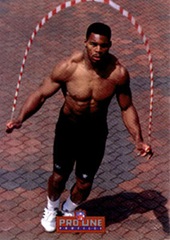
To say that Herschel Walker’s training methods are unorthodox would be an understatement. One of the few players in modern American football to achieve elite status with minimal free weight training, Walker has frequently attributed his freakish strength and power to an intense morning workout regimen consisting mainly of 2,500 sit-ups and 1,500 push ups (doing up to 100 at a time).

An All-American running back at the University of Georgia, a star in the USFL (1983-1985) and the NFL (1986-1997), a sixth degree black belt in Tae Kwon Do, a member of the 1992 U.S. Winter Olympic two-man bobsled team, a world-class sprinter and now a mixed martial artist, Walker will debut in the January 30, 2010 Strikeforce: Miami event at the age of 47. An athletic and genetic marvel, Walker is one of the rare athletes who has competed in divergent athletic nodes at world-class levels.

Yet, Walker didn't start out as an athletic freak. In his book, Herschel Walker’s Basic Training, Walker confesses that he was a burly kid who was often picked last for teams and his sister could consistently beat him in foot races. Through dedication, hard work and the discipline required to complete his intense daily workouts, Walker was able to maximize his raw physical talent and train his body to perform at an elite level in many different athletic nodes.

As athletes in THE GAME, our bodies will often require us to perform physically different tasks at a top level when we transition in/out of divergent nodes (sometimes, very quickly); especially in the transitional zones. That is why studying how Herschel Walker physically prepares himself could give us insight into ways of building a strong foundation of fitness for THE GAME.

Fortunately for us, Herschel Walker and Terry Todd, PhD detailed Walker’s unorthodox training regimen in the aforementioned Herschel Walker’s Basic Training. In the book, Walker outlined his recommended 12-week beginner, intermediate and advanced training programs; incorporating calisthenics (including, of course, push ups and sit-ups), plyometrics, martial arts, basketball, swimming pool workouts, sprinting, running and eventually some free weight training.

Over the course of the next several weeks we will share with you the advanced training program offered in Walker’s book. While following the routines may not give us the power, speed and explosiveness of Herschel Walker (remember that Walker has the rare genetics to respond to this type of training), it will build a solid foundation that, if necessary, can be augmented by a personalized team or individual training program.

THE ADVANCED PROGRAM (courtesy of Herschel Walker’s Basic Training)

Herschel’s comments: “…do the exercises in the order listed, so that your body will be properly warmed up and prepared for each of them. If you decide to take a break between your weight work and basketball work—rather than going directly to the courts after you lifting—make sure that you restretch before you begin to play, to get properly warmed up… ”

WEEK ONE: Monday, Friday—Morning Session

Warm-ups: 20 jumping jacks. Run in place for 4 minutes.

Stretching: Perform each of the 7 basic stretches once—hold twice for 30 seconds each.

Jogging: 8 minutes.

Karate:

Straight punch—20 per arm

Groin strike—20 per arm

Open-hand strike to face—20 per arm

Roundhouse kick—20 per leg

Front snap kick to the midsection—20 per leg

Front snap kick to the head—20 per leg

Sliding back kick—20 per leg

Agility:

Squat thrust—25

Sideways box hop—35

Backward and forward box hop—35

Half-turn—35

Push ups: 80 total. Do as many as possible, rest, then continue until all 80 have been done. Elevate your feet at least 8 inches.

Sit-ups: 100 total. Try to do these as sets of 50

Stretching: Hold each stretch twice for 30 seconds.

Monday, Friday—Afternoon Session

Warm-ups: 20 jumping jacks. Run in place for 4 minutes.

Stretching: Hold each stretch twice for 30 seconds.

Jogging: 4 minutes.

Weight training:

Power pull—1 x 10 warm-up, 2 x 10 target weight

Squat—1 x 10 warm-up, 2 x 10 target weight

Bench press—1 x 10 warm-up, 2 x 10 target weight

Close-grip bench press—1 x 10 warm-up, 2 x 10 target weight

Bent-forward row—1 x 10 warm-up, 2 x 10 target weight

Crunch—65 (break into sets if necessary)

Twisting sit-up—60 (break into sets if necessary)

Basketball: 20 minutes.

Stretching: Hold each stretch twice for 30 seconds.

Wednesday

Wednesday’s workouts should be identical to those of Monday and Friday except for the weight work in the afternoons. Follow this program on Wednesday for your lifting:

Weight training:

Lunge—1 x 10 warm-up, 2 x 10 target weight

Chin—3 x 10

Curl—1 x 10 warm-up, 2 x 10 target weight

Triceps press—1 x 10 warm-up, 2 x 10 target weight

Weighted sit-up—2 x 15

Leg raise—50

Tuesday, Saturday—Morning Session

Warm-ups: 20 jumping jacks. Run in place for 4 minutes.

Stretching: 7 basic stretches, plus 2 advanced stretches—hold twice for 30 seconds. Do at least 2 advanced stretches at the beginning of each workout from now on.

Jogging: 3 minutes.

Sprinting: 2 x 880-yard strides (quarter to half speed). One 440-yard stride (half speed).

Hill running: 3 x 40-yard strides (half speed).

Dumbbell runs: 2 x 30-yard strides. Make sure to use light dumbbells for this and concentrate on arm position as you run.

Rope skipping: 10 minutes.

Stretching: Hold each stretch twice for 30 seconds.

Tuesday, Saturday—Afternoon Session

Warm-ups: 20 jumping jacks. Run in place for 4 minutes.

Stretching: Hold each stretch twice for 30 seconds.

Karate:

Straight punch—20 per arm

Groin strike—20 per arm

Open-hand strike to face—20 per arm

Roundhouse kick—20 per leg

Front snap kick to the midsection—20 per leg

Front snap kick to the head—20 per leg

Sliding back kick—20 per leg

Basketball: 30 minutes.

Water work:

Run in water—6 minutes

Water karate (kicks and punches)—6 minutes

Modified breast stroke—6 minutes

Power clap and other shoulder and arm work—6 minutes

Stretching: Hold each stretch twice for 30 seconds.

Thursday

Morning and afternoon workouts should be identical to those of Tuesday and Saturday except for the sprinting portion of the morning session. On Thursday mornings substitute the tire pull for hill running. On this first week run 3 x 50-yard strides at half-speed, pulling a tire with 12 to 15 pounds inside it. Then, rather than dumbbell sprints, wear a weighted vest and run 2 x 200-yard strides at half to three-quarter speed.

GAME Formations & Strategy: “The Art of War” by Sun Tzu

sun tzu

Written by military general and strategist Sun Tzu in the 6th century BC, The Art of War is still considered one of the most influential treatises on military matters ever written. Leaders as diverse as Mao Zedong, General Vo Nguyen Giap, Baron Antoine-Henri Jomini, and General Douglas MacArthur have claimed to have drawn inspiration from the work.

Sun Tzu believed that when going into battle, the military formations and strategies utilized were dependent on the state of the physical environment as well as the opponent, rather than a predetermined plan that was strictly adhered to. He believed that careful pre-war assessments, recognizing opportunities (engage in physical conflict only when absolutely necessary and after other non-confrontational means have been exercised) and the ability to be flexible to changing circumstances were essential to waging war successfully.

The Art of War has been applied to many fields outside the military sphere. Participants in fields as diverse as sports, law, politics and management have also found the book very useful.

Since it has proven to be useful for strategy and performance in many diverse nodes, we thought it would be a useful resource for conceiving GAME formations and strategy by linking to a free copy of The Art of War via Project Gutenberg and by giving an overview of its chapters (courtesy of Wikipedia):

The Art of War Chapter Summaries
  1. Laying Plans explores the five fundamental factors that define a successful outcome (the Way, seasons, terrain, leadership, and management). By thinking, assessing and comparing these points you can calculate a victory, deviation from them will ensure failure. Remember that war is a very grave matter of state.
  2. Waging War explains how to understand the economy of war and how success requires making the winning play, which in turn, requires limiting the cost of competition and conflict.
  3. Attack by Stratagem defines the source of strength as unity, not size, and the five ingredients that you need to succeed in any war.
  4. Tactical Dispositions explains the importance of defending existing positions until you can advance them and how you must recognize opportunities, not try to create them.
  5. Energy explains the use of creativity and timing in building your momentum.
  6. Weak Points and Strong explains how your opportunities come from the openings in the environment caused by the relative weakness of your enemy in a given area.
  7. Maneuvering explains the dangers of direct conflict and how to win those confrontations when they are forced upon you.
  8. Variation in Tactics focuses on the need for flexibility in your responses. It explains how to respond to shifting circumstances successfully.
  9. The Army on the March describes the different situations in which you find yourselves as you move into new enemy territories and how to respond to them. Much of it focuses on evaluating the intentions of others.
  10. Terrain looks at the three general areas of resistance (distance, dangers, and barriers) and the six types of ground positions that arise from them. Each of these six field positions offer certain advantages and disadvantages.
  11. The Nine Situations describe nine common situations (or stages) in a campaign, from scattering to deadly, and the specific focus you need to successfully navigate each of them.
  12. The Attack by Fire explains the use of weapons generally and the use of the environment as a weapon specifically. It examines the five targets for attack, the five types of environmental attack, and the appropriate responses to such attack.
  13. The Use of Spies focuses on the importance of developing good information sources, specifically the five types of sources and how to manage them.

THE GAME Gear: Makkar Pure Power Mouthguard

PPM

The Makkar Pure Power Mouthguard (PPM) is a custom-fitted mouthguard used to align the lower jaw in its most comfortable and stable position; increasing one’s strength, balance, flexibility and endurance. Based on decades of neuromuscular dental research, the Makkar PPM is based on the premise that the position of the lower jaw can have a tremendous effect on the lower body.

The PPM is different from the traditional mouthguard that can be purchased at sporting goods stores, and even from the custom-fitted ones dentists often make. In order to fabricate a PPM, a neuromuscular dentist will relax the muscles of the jaw (more on this later)/ to find a "verifiable position" that usually results in a joint socket position that's typically more down and forward. When worn, the PPM will position the lower jaw into this most relaxed position; allowing the brain to focus more on coordinating the lower body instead of coordinating the numerous facial and jaw muscles that are used to stabilize the jaw.

Neuromuscular dentist Dr. Shirley Cheong describes this concept:

Popular Science explains how the jaw position is determined for the PPM and discusses a recent blind crossover study:

The optimal location [of the jaw] for each athlete is determined by delivering a low voltage through the jaw and monitoring the muscles in the face via EMG. The bite is captured at the point of a lowest resistance and the mouth guard is built to those specifications….

[A recent] blind crossover study took 22 male collegiate and professional athletes and tested their vertical jump, bench press and put the athletes through the Wingate Anaerobic Test. Each athlete sat through the detailed fitting procedure for a PPM. For the vertical jump (highest of three) there was a significant increase with the PPM of 67.6 vs 65.3 cm. Bench press showed no significant difference while the Wingate test showed a significant increase in peak power but no difference in average power.”

At a cost of approximately $2000, you need to find a neuromuscular dentist, who has the proper training and equipment, in your area to be fitted for a PPM.

Since it is not being widely used at the moment, the PPM could serve as a legal alternative to gaining a physical edge against your competition in THE GAME .

Etc.: An interview with the creator of the PPM, Dr. Anil Makkar where he explains how he came up with the idea for the PPM (the interview starts on page 17). Shaquille O’Neal, Terrell Owens and Scott McCarron give their video testimonials. Other PPM wearers: Wanderlei Silva (page 12) and the New Orleans Saints.

Finally!

After 28 months of delays, the Boeing 787 Dreamliner finally lifted off on its maiden voyage today. You can see the webcast takeoff, landing and flight highlights here.

Made mostly from composites instead of aluminum and steel, the 787 will cut the cost of flying long-range routes by 15-20%—an enormous leap in efficiency. As for the consumer, the 787 features a wider and taller fuselage and an advanced environmental control system; allowing the cabin pressure to be set lower and increasing passenger comfort.

A beautiful aircraft to behold!

THE GAME: Mergers and Partnerships in College Football

The recent struggles of Michigan and Notre Dame’s football programs prompted Wall Street Journal writer Jason Gay to recently suggest (jokingly) a merger of the two programs as an instant solution for elevating the two programs back to national prominence.

After I read Gay’s article, I remember seeing the following highlight from earlier this NFL season of Miami Dolphins teammates quarterback Chad Henne (from the University of Michigan) throwing a 50 yard touchdown pass to wide receiver Ted Ginn, Jr.  (from Ohio State University)…

…and I started to think about different recommendations and guidelines that could be used to merge teams (and the reasons to merge them in the first place), specifically in college football, and THE GAME in general. Here are the notes:

1. Inter-conference matchups. Using men’s college basketball’s early season SEC/Big East Invitational and the ACC-Big Ten Challenge inter-conference matchups as a model, two or more teams from the same conference can temporarily merge to face another set of teams from another conference. These types of matchups can serve several purposes:

  • since the college football season does not include preseason tune-up games like in the NFL, inter-conference matchups allow teams to play in an actual game without extending their players for an entire game. 
  • during the initial rollout of these types of games, wins and losses would not count towards a team’s record for a given season. However, these matchups would help determine a conference’s relative strength, which in turn could help a team’s national ranking (if said team is in a relatively stronger conference) as the season progresses.

2. “Tag-Team” football—a newly created node. If NCAA bylaws could be modified regarding the status of red- and gray-shirt athletes, college football programs could merge their red- and gray-shirt players with other colleges’ red and gray shirts players and play an entire season against similarly constructed teams in an independent “tag-team” football league (e.g. the Pioneer Football League). By merging programs, the constituent programs can essentially share the cost of running a player development program (yes, this could further thin the blurry line that already exists between the amateur student athlete from the professional athlete). Mergers of programs could either be aligned through conference affiliations or independently (an ideal arrangement could be a university from a major conference partnering with a university from a mid-major conference to go up against institutions that have similar relationships).

3. Teams will want to merge with other teams that share similar offensive and/or defensive philosophies and approaches (if they are involved in matchups as explained in 1. and 2. above). This will help maintain consistency in player development. Players who are committed to college football programs that run a certain offensive scheme (for example, a spread option attack) or defensive scheme (3-4 vs. 4-3) will be teamed with players from other programs that run the same type of offense.

4. Preserve traditional rivalries by avoid pairing teams who are bitter rivals. So one would never see the following teams merge: Michigan-Ohio State, Alabama-Auburn, USC-UCLA, West Virginia-Pitt, Texas-Texas A&M, Army-Navy, etc..

5. The rules and guidelines discussed here could be applied and modified to the NCAA’s Divisions I (Football Championship Subdivision), II and III, the NAIA and the NJCAA.

6. Coordinating a joint program from schools that are in different geographic locations would be challenging but not impossible. Incorporating a modular approach to offense and defense would likely be the best method of merging teams together that are geographically separated. Each team that makes up the bigger team would have all the positions within a module practice together to build cohesion within that module. So by having wide receivers, running backs and quarterbacks practice as one module, offensive linemen and running backs practice as another module, safeties and cornerbacks practice as another module, etc., a merged team could, with minimal practice time together in a shared physical location, establish and maintain a high degree of play while simultaneously preserving the merged team’s ability to mix up plays and packages.

Technologies such as videoconferencing joint team meetings and collaborative internet applications for coaches and players could also help merged teams bridge the geographic gap as well.

7. Composition of the coaching staff of the merged program. With the time constraints involved in coaching college football (including coaching, recruiting, alumni relations, etc.) the composite staff of merged teams would likely consist of a staff hired by the merged universities with a prearranged agreement as to how many coaches each university would supply to the endeavor. Those who are interested in pursuing coaching at the college level could eventually utilize opportunities provided by these partner universities as a way to begin their journey “up the coaching ladder”.

8. Uniforms and school colors. There could be plenty of variation here depending on the degree of integration. Some ventures may choose to have completely new composite home and away uniforms created to reflect both institutions. For the sake of tradition, other universities may choose to keep their respective helmets the same and create new uniforms to reflect the merger. And others may decide to keep their traditional uniforms intact; varying only the home or road colors with their partner university. A lot of different combinations are possible.

9. Occasionally sprinkle in some inter-regional “superpower matchups”. Texas & Alabama vs. Notre Dame & Ohio State quickly comes to mind as a North-South power matchup that features big names while avoiding the merger of traditional rivals.

What other recommendations and guidelines can you think of? We’d like to hear your ideas. You can comment here or go to THE IdeaBOARD >> to explain and discuss your ideas.

THE GAME: Node Links

1. David Stern, commissioner of the NBA, thinks that a woman will break through the gender barrier and play in the NBA…within the next decade.

2. Get ready for a new way to window shop! In the coming weeks, Google is going to distribute over 100,000 QR code stickers to “popular” businesses based on search results from users interacting with local business listings on Google Maps. The idea is for small businesses to place these stickers on their storefront window; allowing customers to scan the 2-D barcode with their cell phone’s code reader and opening up new possibilities for businesses to reach their customers (special offers, customer reviews, photos, etc.). We talked about this concept of bridging the physical and digital worlds in a previous post.

3. An interesting analysis from Chris Brown of Smart Football on how the Oregon Ducks utilize the zone read of the defensive tackle, a nuance in the zone read option run game.

4. The world’s first commercial passenger spacecraft:

VSS Enterprise

 More about the VSS Enterprise.

THE GAME In Pictures: A Basic GAME Formation Action Shot #2

kaka G.3

The next image in our series of GAME action shots referencing our post on the first basic GAME formations, (module #1) power-speed formation, features Brazil National, Real Madrid midfielder and GAME SC Kaka. Using his size and pace, Kaka has broken through the first line of defenders; entering the defense’s second level. England National and Liverpool midfielder Steven Gerrard pursues while free safety Oshiomogho Atogwe (foreground) of the St. Louis Rams moves forward to help defend against Kaka’s penetration.

THE GAME: What’s Your Perspective?

perspective

If you are a regular visitor to this site, you will notice that I view THE GAME through the lens of American football…a lot. Growing up in Chicago and attending the University of Michigan as an undergraduate, football becomes a natural passion.

Growing up in the United States, I was not exposed to sports like rugby union, or rugby league, handball, Australian rules football, International rules football, cricket, Gaelic football, field hockey, etc. These are sports that I find infinitely fascinating, but thanks to those of you online, I’m still learning the nuances of these competitions.

In the interest of building an open GAME, I’m interested in seeing how those of you who grew up with and are passionate fans of other sports, view THE GAME from the standpoint of strategy and formations, styles of play, GAME node synthesis, transitions into and out of other nodes, field of play design, position skill sets, GAME hybrids, GAME blends and so forth. In much the same way chefs from different backgrounds and experiences may take the same four ingredients and produce vastly divergent culinary creations, THE GAME should consist of ideas and competitions that reflect the backgrounds and experiences of its participants and innovators.

In the future, I would like to feature some our readers’ fresh perspectives and innovations to THE GAME. If you would like to contribute new ideas and perspectives, please visit THE IdeaBOARD and leave your valuable input there. I will post some of the more interesting content from there here. 

THE GAME: THE GAME 2009

This is the week of the Michigan-Ohio State game.

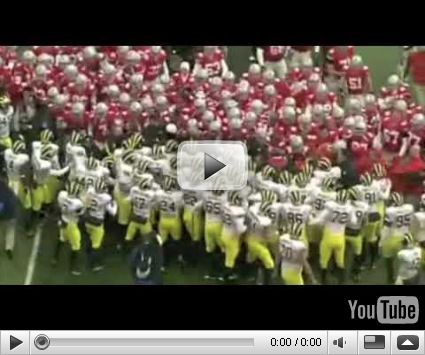
Rated by ESPN in 2000 as the greatest sports rivalry in North America, there is perhaps no other rivalry in college sports that shares such a dysfunctional symbiosis. Characterized by fans who despise the other program while simultaneously maintaining a respect for their rival and the rich history of the conflict, this Saturday’s game in Ann Arbor will be the 106th meeting.

Some pregame hype ensues:

GO BLUE!

THE GAME In Pictures: A Basic GAME Formation Action Shot

tebow & williams

Using GIMP 2.6.6 and referencing this post, I remixed photographs of Tim Tebow and Deron Williams running the basic GAME formation: (module #1) power-speed formation. The image captures the moment after Deron Williams has passed the football to Tim Tebow; allowing Tebow to cross in front of Williams and look for a playmaker on the left wing. After the exchange, Williams begins to angle hard to his right, eluding his defender and creating space to either continue the play by himself, pass to another playmaker on the wing or handoff to a ThB charging from the rear.

THE GAME Gear: Motorola DROID

Here is a review of the new Motorola DROID smartphone courtesy of phoneArena.com.

The Motorola DROID is an Android-powered smartphone for Verizon Wireless. It sports clean lines and a side-sliding design, which allows for a four-row QWERTY keyboard. The display is pretty big - 3.7 inches, while other features include a 5MP camera, microSDHC slot, GPS and Wi-Fi.

Pro Wrestling…The NBA…Same Difference

Hulk Hogan_Dennis Rodman_Karl Malone

For decades, NBA fans have speculated (particularly during the playoffs) that the NBA gives “star” players preferential treatment and/or manipulates the outcomes of games through the actions (or inactions) of their officials. The league has vigorously denied these accusations in the past, but now disgraced former NBA referee, Tim Donaghy is claiming in his new book, Blowing the Whistle, that there is a “rampant culture of fraud” in the league.

Interestingly the book’s pubisher, Triumph Books was ready to begin printing the book until the NBA came calling (excerpt courtesy of Deadspin):

About 10 months ago, (Donaghy) shopped the book to Triumph Books, an imprint of Random House, according to a source close to Donaghy. Triumph, the source says, "put forth a huge effort to verify every statement in that book." (Triumph's editorial director, Tom Bast, declined to comment.) Two weeks ago,Blowing the Whistle was ready for printing; 60 Minutes had plans to interview Donaghy in conjunction with the book's publication. Then the NBA came calling. "They came after Random House and threatened a lawsuit," the source says, "and Random House just rolled and decided to not go with it. It's really that simple." To his knowledge, no one at the NBA had actually read the book.

There are many reasons to simply dismiss Donaghy’s claims based on his character, current financial status, relationship (or lack thereof) with his former employer and colleagues, etc.. But, I can’t help but think of how quickly I dismissed Jose Canseco’s claims of rampant steroid use in Major League Baseball when he came out with his book, Juiced. Sadly, as we all know now, the majority of what he claimed was truthful. Certainly, most of what Donaghy claims in his book could be lies, but NBA conspiracy theorist now have someone who worked on “the inside” finally corroborating what they have suspected all along.

Mark Cuban Endorses Medically Supervised Steroid Use

mark cuban

He’ll clearly get some negative publicity for his endorsement of medically supervised steroid use for athletes who are recovering from injuries, but in Mark Cuban’s world any publicity is good publicity. Publicity aside, I find nothing wrong with what he is saying.

There are currently millions of Americans who are taking steroids for various medical conditions. And yes there is a gray area with athletes who, if Cuban has his way, may be prescribed steroids for conditions and injuries that are not life threatening. But, it seems reasonable to allow an athlete who makes his/her living pushing his/her body beyond its physical limits (training and conditioning, games, injuries, surgeries, etc.) year after year, to use a medically approved and medically monitored substance to speed up healing.

There are some obvious regulatory issues associated with implementing such a program and defining what specific dosages are medically appropriate for what athletes (for instance the amount of steroids a long distance runner would need may not be the same amount of steroids that a three hundred pound professional wrestler needs to receive a therapeutic benefit); perhaps requiring a medical board to review an athlete’s use on a case-by-case basis. But, as many of us know a bureaucracy rarely get things done in a timely manner. By the time a medical board approved a hypothetical steroid regimen for an athlete, such a regimen may not even be necessary since the athlete may already have healed on his own.

Whether such a program could be instituted at this point is irrelevant since the powers that be in athletics are terrified to even entertain the thought of such a program in light of the recent Major League Baseball steroid scandal. But, kudos to Mark Cuban for bringing up the issue and at least starting the conversation.

The Vatican Opens its Doors to Anglicans

Pope Benedict XVI1 

The spiritual side of a Game is not something we’ve ever discussed here, but I came across this fascinating article by Jacqueline L. Salmon and William Wan of The Washington Post regarding the invitation by the Catholic Church to those in the Anglican Communion who have become disillusioned by the Church’s social and theological direction:  “In a remarkable bid to attract disillusioned members of the Anglican Communion, the Vatican announced Tuesday that it is establishing a special arrangement that will allow Anglicans to join the Catholic Church while preserving their liturgy and spiritual heritage, including married priests.”

The growing schism within the Anglican Church can be traced to the 2003 ordination of Gene Robinson, a gay man, as bishop of New Hampshire as well as over female clergy and ritualism. It is believed that between 100 and 200 of the 7,000 Episcopal congregations have broken away from the larger Anglican Communion.

An excerpt from the article:

The Catholic Church's plan "reflects a bold determination by Rome to seize the moment and do what it can to reach out to those who share its stance on women priests and homosexuality," said Ian Markham, dean of the Virginia Theological Seminary, an Episcopal seminary in Alexandria. "It is very, very bold and very interesting."…

…Under the system, the Catholic Church will create "personal ordinariates"--separate units within Catholic churches headed by former Anglican priests or bishops. While married Anglican priests would be permitted, married bishops would not because they are not in keeping with Catholic tradition. These former Anglicans would be considered theologically Catholic but with their own traditions, such as use of the Anglican Book of Common Prayer....

…Conservative Anglican leaders in the United States say the impact will be greater in England than it is here. "The British papers are saying it's the biggest thing since Henry VIII, and in some ways it is for them," said Rev. Martyn Minns of Fairfax City (VA), leader of a group of conservative congregations that broke three years ago from the Episcopal Church. "Over there, you have bishops, congregations, even whole diocese that may shift. Here in the U.S., we've already faced the division and what came out of it was the Anglican alternative.…What the pope said affirms what I'm doing, but doesn't mean I'm going to become Catholic." But other conservative Anglican leaders, including those with strong Catholic leanings, said Tuesday that they are unlikely to join the Catholic Church.

Update #1: An analysis from the New York Times. Rachel Donadio speculates whether opening its doors to Anglicans, could eventually liberalize the Catholic Church on a crucial issue: celibacy.

G Level: Glory >> Notre Dame vs. USC

This past weekend, USC barely held on for a thrilling win over Notre Dame, 34-27.

In my previous post, I touched on the subject of GAME Levels and one level in particular: the “glory” level. In that post, I showed a clip from the 2008 USC Flashback Fantasy Camp where those in Trojan Nation (typically middle-aged or thereabouts) get the opportunity to be coached by the USC coaching staff.

Without further ado, I present to you the incoming USC Trojans Flashback Class of 2008:


…and now the incoming Notre Dame Fighting Irish Fantasy Camp Class of 2008:

Notre Dame is currently listed as a 24 point favorite in the glory matchup.

A New Era for Auburn Football?

colonial_lowder On the one hand, Bobby Lowder was the founder and CEO of Colonial Bank, the former regional banking powerhouse and now a part of BB&T; on the other hand, he was the most powerful and influential trustee and booster at Auburn University.

He often mixed his two passions, blurring the line between his business and Auburn football.

Now that his bank is gone (the sixth largest bank failure in U.S. history and the largest bank failure of 2009) and his influence on the Board of Trustees at Auburn is diminished, many are wondering if there are better days ahead for Auburn University and Auburn football.

Fortune analyzes the man who many considered “the most feared, loathed, and…misunderstood men to wield power in [Alabama] since George Wallace”.

The First Basic GAME Formations, Circa 1999…Updated 2009, Part One

Back in 2000, I slotted, what were then, contemporary players into the various formation modules based on the players’ skill sets and what the positions’ requirements were. I thought it would be fun to revisit the first post about GAME formations by inserting today’s players into the formations while detailing the needs of each position some more. The following depth chart is for the power-speed formation module at the top of the diagram.

GAME-Blue-Formation-1

Module #1 power-speed formation depth chart:

SCDeron Williams (G, Utah Jazz), Kaká (MF, Real Madrid). This module’s position requires a strong decision maker with size, strength, quickness and the ability to distribute the ball precisely. The decisions that the SC make are based on the alignment and/or (expected) degree of penetration by the defense. Reacting to the defensive alignment, the SC will distribute the ball to the ThB’s in the rear, pass or lateral to the outside wings where wing playmakers (W) are aligned within separate wing modules, or keep the ball to achieve forward progress.

ThB: Tim Tebow (QB, University of Florida), Dan LeFevour (QB, Central Michigan University). This position requires a player who has the rare ability to accurately make all throws or kicks, run with elusiveness and run with power. Power is important in this position since the defense is aligned in close proximity. This ThB can either block/guard larger defenders, receive the ball and accurately distribute to ThB’s behind or to playmakers on the wings, or keep the ball to achieve forward progress.

ThB: Terrelle Pryor (QB, Ohio State University), Juice Williams (QB, University of Illinois), Dan Carter (Fly-half, USA Perpignan and the Crusaders). This position is similar to the ThB previously described, but throwing is not as essential of a requirement. The ability to pass or kick forward at this position is important in order to keep the defense off balance, but the majority of the time these ThB’s will keep the ball or distribute the ball laterally to a teammate. As a result, these ThB’s must have power, elusiveness and speed.

ThB: Boris Diaw (F/C, Charlotte Bobcats), Pau Gasol (C, Los Angeles Lakers). Diaw and Gasol are considered two of the best passing/outlet passing athletic big men in basketball. The primary physical attribute necessary for this position is size. As ThB’s are positioned further behind the frontline, visualizing the action on the field becomes more challenging. That is why it is necessary to have an excellent passing big man with good decision making skills positioned in the middle of the ThB formation to do the following: read the defensive formation and movement; analyze the progress of the ThB’s in the front (against the defense); adjust the call/play or continue with the planned call/play based on the two main reads; pass to the appropriate playmakers based on the reads.

ThB: Pat White (QB, Miami Dolphins), Seneca Wallace (QB, Seattle Seahawks). The next two rows of ThB’s are the best combination of speed, quickness and arm strength. Agile and elusive, these ThB’s can make plays with their game-breaking speed or with their arms. They can throw to playmakers positioned on the wings, launch balls to playmakers in other nodes or dart into/out of nodes by using their speed to slice through zones.

ThB: Michael Vick (QB, Philadelphia Eagles), Denard Robinson (QB, University of Michigan).

ThB: Donovan McNabb (QB, Philadelphia Eagles), Jay Cutler (QB, Chicago Bears. The next two rows of ThB’s have the best arms. This row has better movement and elusiveness than the following row; speed is not an essential attribute but a plus. The ability to throw the ball into other nodes and across zones is essential. Although these ThB’s may not have speed, they should have good lateral movement in order to laterally mirror the movements of ThB’s in the front rows (in the event ThB’s in front lateral, pass or kick to them) and the ability to laterally track the ThB’s behind them (in order to lateral, pass or kick to them).

…ThB: Ben Roethlisberger (QB, Pittsburgh Steelers), Ryan Mallett (QB, University of Arkansas). Also known as “Towers” or “Throwers”, these ThB’s have size, strength and superb arm strength. Their goal is to fire balls to participants in other nodes, across zones or on the wings: to transition play into other nodes and zones; to advance the offense in their own zone of play. They may not exactly mirror the movements of the ThB’s in the front rows, but they must remain in the zone of action in order to receive a lateral, pass or kick.


Connect with G.3

Node Universe

"i am not a cop" (1) 2009 (33) 2010 (24) 2011 (8) 2012 (6) 2016 olympics (1) a11 offense (1) AAFL (1) about THE GAME (44) aesthetics (1) alissa quart (1) alt rock (7) alternate universes (7) alternative hip hop (1) amber (1) american football (34) anderson (1) andres iniesta (1) anglican church (1) anthony bourdain (1) anthropology (1) antonio brown (1) apple (2) apple iphone 4 (1) archery (1) architecture (1) armin van buuren (1) army (1) arsenal (1) art (2) astronomy (1) athletics (2) atlanta falcons (1) atlanta thrashers (1) auburn tigers (1) australia wallabies (1) australian rules football (2) austus (1) aviation (1) babe didrikson zaharias (1) babylon 5 (1) bacary sagna (1) banking (1) barack obama (2) baseball (2) basketball (12) battles (1) battlestar galactica (1) beauty pageants (1) berrick barnes (1) big ten (3) bill goldberg (1) bill simmons (1) black headlines (1) blackberry (1) blackberry torch (1) bo jackson (2) bob hayes (1) bob sapp (1) boeing 787 dreamliner (1) books (13) boxing (2) bret michaels (1) brian boitano (1) brit rock (1) brooks orpik (1) business (7) calcio fiorentino (1) carol leifer (1) catholic church (1) celebrity apprentice (2) chad henne (1) charles woodson (1) charlie ward (1) chess (1) chess boxing (2) chevelle (1) chicago (band) (1) chicago blackhawks (1) chicago cubs (1) chicago white sox (1) child development (1) chris johnson (1) chrome browser (1) claudio reyna (1) cleveland browns (1) cleveland cavaliers (1) cloud computing (2) coachella (1) coldplay (1) college football (13) colorado avalanche (1) comic books (1) commercial (6) complementary currency (1) computer animation (1) corruption (1) cristiano ronaldo (1) culture (3) curtis stone (1) cyndi lauper (1) cypress hill (1) dance (16) darryl strawberry (1) dave winfield (1) david akers (1) david beckham (1) david sills (1) deion sanders (1) dell (1) denard robinson (2) dentistry (2) denver nuggets (1) depeche mode (1) derek jeter (1) deron williams (1) desmond howard (1) diagrams (3) didier drogba (1) digital and physical convergence (7) dmx (1) donald trump (1) downloads (1) dr. dre (1) drew brees (1) early humans (1) east coast rap (2) economics (1) electronic (15) electronics (9) endodontics (1) entertainment (42) entrepreneurship (2) entropia (1) erasure (1) espn (3) ethics (1) eurodance (5) evander kane (1) evanescence (1) evo 4g (1) fantasy (3) fernando torres (1) ferry corsten (1) fifa world cup (1) figure skating (1) fitness (1) flexbone (1) football (12) formations (6) free culture (1) fugoo (1) G (c.2000) (105) G Levels (6) G rules/guidelines (15) G Types (12) G: grouped (style) (4) G: jacks (1) G: mix (hybrid) (34) G: specific (60) G: transitional (21) G.3 (109) G.3 scenarios (3) gaelic football (3) galaxy (1) gatorade commercial (1) gavin floyd (1) gender (1) georgia tech yellowjackets (1) girl talk (1) goal line blitz (1) golf (1) good charlotte (1) google (4) google earth (1) gothic (1) gray headlines (2) gregg gillis (1) grunge (1) guiness book of world records (1) guru josh project (1) habbo hotel (1) haddaway (1) haka (1) halo (1) hardlinks (1) herschel walker (10) hierarchy (1) high school football (1) hilary levey friedman (1) hip hop (9) holly robinson peete (1) hollywood (2) hot stove league (1) house (3) house of pain (2) htc (1) hybrid G Types (12) hybrid sports (11) hype williams (1) hypertrophy (1) i-formation (1) ice hockey (5) indianapolis colts (1) institute for aesthletics (1) international rules football (4) internet (8) intro-inspection (1) ipad (1) jackie robinson (1) jamal lewis (1) jamelle holieway (1) jay walker (1) jay-z (1) jim brown (1) jim thorpe (1) joe decker (1) john elway (1) jose canseco (1) journalism (1) kaka (2) kaneva (1) kelis (1) keven mealamu (1) kevin kelly (1) kid muscle (1) kobe bryant (1) la bouche (1) la coka nostra (1) lane kiffin (1) LARP (1) laura kaeppeler (1) LBG (1) lebron james (1) life (1) linden labs (2) links (1) lionel messi (1) literature (1) logos (1) luciana (1) madonna (1) makkar ppm (1) malcolm glazer (1) manchester united (1) maps (1) maria kanellis (1) mark cuban (1) mashup (3) MCUIs (2) medicine (1) megaband (1) megasoccer (1) member stream (1) memory spot (1) mercury...the sport (1) meta browsing (2) meta layout (1) meta page (2) metal (3) metaverse (5) mia hamm (1) miami dolphins (1) michael bay (1) michael essien (1) michael jackson (1) michael johnson (1) michael mann (1) michael vick (1) michigan wolverines (5) mike tyson (1) military (2) mirror worlds (3) miss america (1) mlb (3) MMA (4) MMORPG (1) modern humans (1) montell jordan (1) moove (1) motorola (3) motorola atrix (1) motorola droid (1) motorola droid x (1) movies (2) ms virtual earth (1) multi-monitor productivity (2) multiverse (1) music (39) music videos (35) myron rolle (1) mytago (1) NAA (1) navy headlines (1) nba (8) nbc (4) NCAA (10) neanderthals (1) neuromuscular dentistry (1) new orleans saints (1) newspapers (1) nexus one (1) nfl (7) nhl (2) night ripper (1) nike (2) nintendo entertainment system (1) nirvana (1) no reservations (1) non phixion (1) notre dame (3) npr morning edition (1) nyc (1) nz all blacks (2) obscura visonaire interface (1) offense (5) ohio state buckeyes (4) on demand (1) onlive (1) open call (1) oregon ducks (2) oshiomogho atogwe (1) osymyso (1) ou sooners (1) outkast (1) palm (1) palm pre (1) pantera (1) pat white (2) patrick willis (1) paul johnson (1) pentagon (1) personalized search (1) peyton manning (1) pharao (1) phil mickelson (1) physiology (1) pittsburgh penguins (1) pittsburgh steelers (1) politics (2) pop (3) powerpop (1) premier league (1) presidential inauguration (1) pro wrestling (2) pro/NCAA hybrid (3) pros vs. joes (1) punk pop (1) QR codes (1) quantum physics (1) r and b (2) rap (9) ray lewis (1) reality TV (2) reggie bush (1) religion (1) restaurants (1) rewilding (1) rich rodriguez (2) richard belzer (1) richard vission (1) RIM (1) rio de janeiro (1) rob powell (1) rock (5) rod blagojevich (1) ruff ryders (1) rugby (4) rugby league (2) rugby union (3) run and shoot (1) ryan dempster (1) sash (1) sci-fi (3) science (8) scott mccarron (1) scott steiner (1) second life (2) sega joe montana football (1) selita ebanks (1) semantics (1) semapedia (1) shane o'brien (1) shaquille o'neal (1) sharon den adel (1) sharon osbourne (1) shawne merriman (1) showdown in chinatown (1) sinbad (1) site news (1) smartphones (3) snap (1) sociology (1) sonique (1) sound opinions (1) space (1) space travel (1) spacecraft (1) spider-man (1) spike tv (1) spirit (1) sports (65) sports science (1) spread option (2) stadiums (1) stan kroenke (1) stanley cup (1) star trek (1) star wars (2) starfruit (1) static revenger (1) steroids (2) steve clarkson (1) steve nash (1) steve sokol (1) steven gerrard (2) steven jackson (1) strategy (7) strength and conditioning (11) summer olympics (1) summer sanders (1) sun tzu (1) swat (1) synth pop (1) system of a down (1) taxonomy (2) tech (21) tecmo super bowl (1) TED (1) ted ginn jr. (1) ted lilly (1) terrell owens (2) the 80's (3) the 90's (23) the art of war (1) THE GAME gear (9) THE GAME in pictures (8) THE GAME in video (1) THE GAME training (12) THE GAME vision (110) the ideaboard (4) the ideaboard toolbar (1) the killers (1) the last of the mohicans (1) the national sports daily (1) the notorious b.i.g. (1) the prize (1) theater (1) there (1) tim donaghy (1) tim tebow (1) tina cousins (1) top 10 lists (2) trance (6) transformers (1) travel channel (1) triple option offense (1) troy polamalu (1) tupac shakur (2) TV (6) universal football (1) universal search (1) usability (1) usain bolt (1) usc trojans (4) USMNT (1) video games (2) vince carter (1) virtual economy (1) virtureality (6) vook (1) vss enterprise (1) wanderlei silva (1) wars (2) water polo (1) wayne rooney (1) wcw (1) wcw nitro (1) west coast rap (2) west virginia mountaineers (2) wiffle hurling (1) william orbit (1) winnipeg jets (1) wired magazine (1) wishbone offense (2) workouts (12) world fitness championship (1) world's fittest man (1) worlds crossover (5) wrestlemania (1) wwe (1) xavi (1) zones (3)

Popular Content on 'G.3 is...'

Home | About THE GAME (G.3) | About 'THE GAME (G.3) is...' | THE GAMEology | GWikipedia | THE IdeaBOARD

Copyright ©2012 THE GAME, G1, G.3, THE GAME Meta, G Meta, THEGAME-online.com and G1 Ventures. This work is licensed under aCreative Commons Attribution-ShareAlike 3.0 Unported License.Some rights reserved. This website is an unofficial and independent source of aggregated news, information, technologies, entertainment, created works and services, and is not affiliated, unless otherwise noted, with an individual, institution, or organization. The names of actual companies and products herein may be the trademarks of their respective owners. Portions of the content and products herein are copyrighted. Copyrights to these works belong to their respective rightsholders. The opinions expressed, and the products and advertisements placed on this website may not necessarily be endorsed by the aforementioned individuals, institutions or organizations.