
THE GAME Gear: Motorola ATRIX 4G
With dual-core 1 GHz NVIDIA Tegra processors and 1GB of DDR2 RAM on board, the Motorola ATRIX is the most powerful smartphone on the market. Taking advantage of all this processing power, Motorola has positioned the ATRIX, running on Android 2.2 Froyo, as a mobile device with PC power; integrating the functionalities of a PC and a smartphone seamlessly into one device.
The fun really begins when connecting the ATRIX to an optional docking station or a laptop dock powered by the phone itself. Via its Webtop app, the ATRIX can turn into a PC that runs a true desktop Firefox browser and Flash 10:

Motorola has been receiving a ton of positive buzz after it unveiled the ATRIX at the CES last week and rightly so. But, it is baffling to me that Motorola would release this beautiful device exclusively through AT&T, a carrier who has struggled with service and connection issues—real and perceived (ask anyone who has an iPhone or any phone on the AT&T network for that matter). Gadget geeks will likely flock to the stores, in spite of the carrier, in order to be one of the first to get their hands on an ATRIX (I’m already counting down the days until I see the first unboxing video on YouTube). Who knows if the joy found in the user experience will be overshadowed by the frustration that may come with using AT&T’s network. I would love to get my hands on an ATRIX on March 1, but at the cost of several hundred dollars and a two year contract, I think I’ll safely stand on the sidelines until I know AT&T has got their act together.
I hope they do.
THE GAME Training: Herschel Walker’s Advanced Training Regimen, Week Seven

Here is week seven of Herschel Walker’s recommended advanced training regimen from his book, Herschel Walker’s Basic Training.
Week One | Week Two | Week Three | Week Four | Week Five | Week Six
THE ADVANCED PROGRAM
WEEK SEVEN: Monday, Friday—Morning Session
Warm-ups: 35 jumping jacks. Run in place for 4 minutes.
Stretching: Hold each stretch twice for 30 seconds.
Jogging: 14 minutes.
Karate:
Straight punch—42 per arm
Groin strike—42 per arm
Open-hand strike to face—42 per arm
Roundhouse kick—42 per leg
Front snap kick to the midsection—42 per leg
Front snap kick to the head—42 per leg
Sliding back kick—42 per leg
Agility:
Squat thrust—50
Sideways box hop—65
Backward and forward box hop—65
Half-turn—65
Push-ups: 130 total. Do as many as possible, rest, then continue until all 130 have been done. Make sure you experiment with different heights to change the resistance.
Sit-ups: 160 total. Again add weight if needed.
Stretching: Hold each stretch twice for 30 seconds.
Monday, Friday—Afternoon Session
Warm-ups: 35 jumping jacks. Run in place for 4 minutes.
Stretching: Hold each stretch twice for 30 seconds.
Jogging: 4 minutes.
Weight training:
Power pull—1 x10 warm-up, 3 x 5 target weight, 1 x 10 with 70% of target
Squat—1 x 10 warm-up, 3 x 5 target weight, 1 x 10 with 70% of target
Bench press—1 x 10 warm-up, 3 x 5 target weight, 1 x 10 with 70% of target
Close-grip bench press—1 x 10 warm-up, 3 x 5 target weight, 1 x 10 with 70% of target
Bent-forward row—1 x 10 warm-up, 3 x 5 target weight, 1 x 10 with 70% of target
Crunch—110
Twisting sit-up—90
Basketball: 45 minutes
Stretching: Hold each stretch twice for 30 seconds.
Wednesday
Wednesday’s workouts should be identical to those of Monday and Friday except for the weight work in the afternoon. Follow this program on Wednesday for your lifting:
Weight training:
Lunge—1 x 10 warm-up, 3 x 5 target weight, 1 x 10 with 70% of target
Chin—1 x 10, 3 x 5 with added weight, 1 x 10 with 70% of target
Curl—1 x 10 warm-up, 3 x 5 target weight, 1 x 10 with 70% of target
Triceps press—1 x 10 warm-up, 3 x 5 target weight, 1 x 10 with 70% of target
Weighted sit-up—4 x 25
Leg raise—110
Tuesday, Saturday—Morning Session
Warm-ups: 35 jumping jacks. Run in place for 4 minutes.
Stretching: Hold each stretch twice for 30 seconds.
Jogging: 6 minutes.
Sprinting: 2 x 440-yard strides (half speed). 2 x 300-yard strides (three-quarter speed). 2 x 200-yard strides. 2 x 110-yard sprints.
Hill running: 9 x 30-yard strides (half to three-quarter speed).
Dumbbell runs: 5 x 30-yard strides. Make sure to use light dumbbells for this and concentrate on arm position as you run.
Rope skipping: 15 minutes.
Stretching: Hold each stretch twice for 30 seconds.
Tuesday, Saturday—Afternoon Session
Warm-ups: 35 jumping jacks. Run in place for 4 minutes.
Stretching: Hold each stretch twice for 30 seconds.
Karate:
Straight punch—42 per arm
Groin strike—42 per arm
Open-hand strike to face—42 per arm
Roundhouse kick—42 per leg
Front snap kick to the midsection—42 per leg
Front snap kick to the head—42 per leg
Sliding back kick—42 per leg
Basketball: 45 minutes.
Water work:
Run in water—14 minutes
Water karate (kicks and punches)—14 minutes
Modified breast stroke—14 minutes
Power clap and other shoulder and arm work—14 minutes
Stretching: Hold each stretch twice for 30 seconds.
Thursday
Morning and afternoon workouts should be identical to those of Tuesday and Saturday except for the sprinting portion of the morning session. On Thursday mornings substitute the tire pull for hill running. On this seventh week run 9 x 50-yard strides at half speed, pulling a tire with 15 to 20 pounds inside it. Then, rather than dumbbell sprints, wear a weighted vest and run 5 x 100-yard strides.
G.3 Scenarios: Kobe Bryant, Basketball, Football and Nodes in Between

When Kobe Bryant was six years old, his father, Joe “Jellybean” Bryant, moved the family to Italy to begin playing professional basketball. It was during these formative years in Italy that Kobe Bryant played football and basketball. When his father retired in 1991, Bryant’s family moved back to the United States, but his passion for football remained.
As a young fan of AC Milan, Bryant had aspirations of being a professional football player; even claiming that if his family had stayed in Italy, he would have chosen professional football over professional basketball. He remarked to the Milan sports daily, La Gazzetta dello Sport, during this summer’s World Cup in South Africa:
“I love soccer since the time I was a boy. From when I lived in Italy and supported AC Milan. Dreaming one day to be Marco Van Basten, one day Diego Maradona and one day Roberto Baggio.”
Byrant has more than just a passing appreciation of football and after these many years, he still feels at home on the pitch and with the football at his feet:

The 2010 NBA season begins tonight and there have been lingering concerns about Bryant’s surgically repaired left knee throughout this offseason. If Bryant could remain relatively healthy through the upcoming season and if he could endure a rigorous football training regimen, his size and athleticism would be an ideal template for a football goalie, backline defender or a forward on set pieces.
If Bryant was in his prime, it is likely that he could have played a center forward position given his athletic and attacking style of play; a style of play that has been very successful for him on a much smaller playing field—the basketball court.
Assuming that we have a Kobe Bryant in his prime, the thought of his potential role as a defenseman (D) or forward (F) in a blended football-basketball G node or a as transitional wing playmaker (W) between football and basketball nodes is tantalizing.
As a defenseman, Bryant, who is already an elite defender in the NBA, could fit in well is as a backline defender who can quickly counter and lead an offensive attack in a defense-offense transition formation (the middle of the three different formation modules bracketed in the diagram below). Given that Bryant’s main sport requires quick bursts of offense to defense and vice versa, his transition as a defender into an offensive catalyst in the defense-offense transition formations would be a relatively easy adjustment to make.

As a forward in the defense-offense transition formation in a blended G node, Bryant could slot into the left or right wings since he possesses the requisite skill set: very good speed, length, strength, long shooting range, passing and decision-making ability, and a strong defensive presence.
As a transitional wing player linking two or more nodes (football and basketball in this example) that are not completely blended but exist in two separate forms simultaneously, Bryant could transition into and out of football and basketball in some of the following ways:
- Shots made from specific spots on the basketball court could activate football set pieces for Bryant or another player to take during the next pause in football and basketball action.
- Long distance shots made from specific spots on the basketball court could award the football team on the same GAME team a man advantage on the pitch for a short finite period of time; much like man advantages in ice hockey.
- A G.3-designed field with a basketball court side by side with a football pitch would allow Bryant to concentrate on his basketball assignments while providing additional zonal marking on the pitch when he is in the corresponding basketball court-football pitch areas (by crossing over the sidelines and freely traversing into and out of the two fields of play as needed).
Elite G.3 performers must excel in multiple individual nodes while at the same time have the flexibility to excel in G nodes that link or blend two or more nodes together. Kobe Bryant may not be the young man he was half a decade ago, but his versatility, athleticism, intelligent play and competitive makeup continues to secure his status as one of the NBA’s and G.3’s elite.
THE GAME Training: Herschel Walker’s Advanced Training Regimen, Week Six

Here is week six of Herschel Walker’s recommended advanced training regimen from his book, Herschel Walker’s Basic Training.
Week One | Week Two | Week Three | Week Four | Week Five
THE ADVANCED PROGRAM
WEEK SIX: Monday, Friday—Morning Session
Warm-ups: 30 jumping jacks. Run in place for 4 minutes.
Stretching: Hold each stretch twice for 30 seconds.
Jogging: 13 minutes.
Karate:
Straight punch—40 per arm
Groin strike—40 per arm
Open-hand strike to face—40 per arm
Roundhouse kick—40 per leg
Front snap kick to the midsection—40 per leg
Front snap kick to the head—40 per leg
Sliding back kick—40 per leg
Agility:
Squat thrust—50
Sideways box hop—60
Backward and forward box hop—60
Half-turn—60
Push-ups: 125 total. Do as many as possible, rest, then continue until all 125 have been done. If these are too easy, elevate your feet at least 8 inches.
Sit-ups: 150 total. Again add weight if needed.
Stretching: Hold each stretch twice for 30 seconds.
Monday, Friday—Afternoon Session
Warm-ups: 35 jumping jacks. Run in place for 4 minutes.
Stretching: Hold each stretch twice for 30 seconds.
Jogging: 4 minutes.
Weight training:
Power pull—1 x10 warm-up, 3 x 5 target weight, 1 x 10 with 70% target
Squat—1 x 10 warm-up, 3 x 5 target weight, 1 x 10 with 70% target
Bench press—1 x 10 warm-up, 3 x 5 target weight, 1 x 10 with 70% target
Close-grip bench press—1 x 10 warm-up, 3 x 5 target weight, 1 x 10 with 70% target
Bent-forward row—1 x 10 warm-up, 3 x 5 target weight, 1 x 10 with 70% target
Crunch—105
Twisting sit-up—85
Basketball: 45 minutes
Stretching: Hold each stretch twice for 30 seconds.
Wednesday
Wednesday’s workouts should be identical to those of Monday and Friday except for the weight work in the afternoon. Follow this program on Wednesday for your lifting:
Weight training:
Lunge—1 x 10 warm-up, 3 x 5 target weight, 1 x 10 with 70% target
Chin—1 x 10, 3 x 5 with added weight, 1 x 10 with 70% target
Curl—1 x 10 warm-up, 3 x 5 target weight, 1 x 10 with 70% target
Triceps press—1 x 10 warm-up, 3 x 5 target weight, 1 x 10 with 70% target
Weighted sit-up—4 x 25
Leg raise—100
Tuesday, Saturday—Morning Session
Warm-ups: 35 jumping jacks. Run in place for 4 minutes.
Stretching: Hold each stretch twice for 30 seconds.
Jogging: 6 minutes.
Sprinting: 1 x 880-yard stride (quarter to half speed). 2 x 440-yard strides (half speed). 2 x 300-yard strides (three-quarter speed). 2 x 200-yard sprints.
Hill running: 8 x 40-yard strides (half speed).
Dumbbell runs: 5 x 30-yard strides. Make sure to use light dumbbells for this and concentrate on arm position as you run.
Rope skipping: 15 minutes.
Stretching: Hold each stretch twice for 30 seconds.
Tuesday, Saturday—Afternoon Session
Warm-ups: 35 jumping jacks. Run in place for 4 minutes.
Stretching: Hold each stretch twice for 30 seconds.
Karate:
Straight punch—40 per arm
Groin strike—40 per arm
Open-hand strike to face—40 per arm
Roundhouse kick—40 per leg
Front snap kick to the midsection—40 per leg
Front snap kick to the head—40 per leg
Sliding back kick—40 per leg
Basketball: 45 minutes.
Water work:
Run in water—14 minutes
Water karate (kicks and punches)—14 minutes
Modified breast stroke—14 minutes
Power clap and other shoulder and arm work—14 minutes
Stretching: Hold each stretch twice for 30 seconds.
Thursday
Morning and afternoon workouts should be identical to those of Tuesday and Saturday except for the sprinting portion of the morning session. On Thursday mornings substitute the tire pull for hill running. On this sixth week run 8 x 50-yard strides at half speed, pulling a tire with 12 to 15 pounds inside it. Then, rather than dumbbell sprints, wear a weighted vest and run 1 x 200-yard stride at half to three-quarter speed and 4 x 100-yard strides.
THE GAME Gear: RIM Blackberry Torch 9800
In an effort to gain market share in the popular touch-screen smartphone market, RIM’s response to the market leader Apple iPhone and Motorola’s recent line of well-received Android phones is the Blackberry Torch.
Perhaps learning from the lackluster response received by the Blackberry Storm, RIM’s first foray into the touch-screen smartphone market, notable changes in the Blackberry Torch include the incorporation of RIM’s iconic QWERTY keyboard as a slide-out keyboard, the new Blackberry OS 6 and a WebKit browser. So how does the Torch’s features and performance stack up with the other phones in its class? PhoneArena presents a video review of the new RIM Blackberry Torch 9800.

THE GAME Training: Herschel Walker’s Advanced Training Regimen, Week Five

Here is week five of Herschel Walker’s recommended advanced training regimen from his book, Herschel Walker’s Basic Training.
Week One | Week Two | Week Three | Week Four
THE ADVANCED PROGRAM
WEEK FIVE: Monday, Friday—Morning Session
Warm-ups: 30 jumping jacks. Run in place for 4 minutes.
Stretching: Hold each stretch twice for 30 seconds.
Jogging: 12 minutes.
Karate:
Straight punch—38 per arm
Groin strike—38 per arm
Open-hand strike to face—38 per arm
Roundhouse kick—38 per leg
Front snap kick to the midsection—38 per leg
Front snap kick to the head—38 per leg
Sliding back kick—38 per leg
Agility:
Squat thrust—45
Sideways box hop—55
Backward and forward box hop—55
Half-turn—55
Push-ups: 120 total. Do as many as possible, rest, then continue until all 120 have been done. If these are too easy, elevate your feet at least 8 inches.
Sit-ups: 140 total. Again add weight if needed.
Stretching: Hold each stretch twice for 30 seconds.
Monday, Friday—Afternoon Session
Warm-ups: 35 jumping jacks. Run in place for 4 minutes.
Stretching: Hold each stretch twice for 30 seconds.
Jogging: 4 minutes.
Weight training:
Power pull—1 x10 warm-up, 3 x 5 target weight, 1 x 10 with 70% target
Squat—1 x 10 warm-up, 3 x 5 target weight, 1 x 10 with 70% target
Bench press—1 x 10 warm-up, 3 x 5 target weight, 1 x 10 with 70% target
Close-grip bench press—1 x 10 warm-up, 3 x 5 target weight, 1 x 10 with 70% target
Bent-forward row—1 x 10 warm-up, 3 x 5 target weight, 1 x 10 with 70% target
Crunch—100
Twisting sit-up—80
Basketball: 40 minutes
Stretching: Hold each stretch twice for 30 seconds.
Wednesday
Wednesday’s workouts should be identical to those of Monday and Friday except for the weight work in the afternoon. Follow this program on Wednesday for your lifting:
Weight training:
Lunge—1 x 10 warm-up, 3 x 5 target weight, 1 x 10 with 70% target
Chin—1 x 10, 3 x 5 with added weight
Curl—1 x 10 warm-up, 3 x 5 target weight, 1 x 10 with 70% target
Triceps press—1 x 10 warm-up, 3 x 10 target weight, 1 x 10 with 70% target
Weighted sit-up—4 x 20
Leg raise—90
Tuesday, Saturday—Morning Session
Warm-ups: 35 jumping jacks. Run in place for 4 minutes.
Stretching: Hold each stretch twice for 30 seconds.
Jogging: 6 minutes.
Sprinting: 2 x 880-yard strides (quarter to half speed). 2 x 440-yard strides (half speed). 2 x 300-yard strides (three-quarter speed). 1 x 200-yard sprint.
Hill running: 7 x 40-yard strides (half speed).
Dumbbell runs: 5 x 30-yard strides. Make sure to use light dumbbells for this and concentrate on arm position as you run.
Rope skipping: 14 minutes.
Stretching: Hold each stretch twice for 30 seconds.
Tuesday, Saturday—Afternoon Session
Warm-ups: 35 jumping jacks. Run in place for 4 minutes.
Stretching: Hold each stretch twice for 30 seconds.
Karate:
Straight punch—38 per arm
Groin strike—38 per arm
Open-hand strike to face—38 per arm
Roundhouse kick—38 per leg
Front snap kick to the midsection—38 per leg
Front snap kick to the head—38 per leg
Sliding back kick—38 per leg
Basketball: 45 minutes.
Water work:
Run in water—14 minutes
Water karate (kicks and punches)—14 minutes
Modified breast stroke—14 minutes
Power clap and other shoulder and arm work—14 minutes
Stretching: Hold each stretch twice for 30 seconds.
Thursday
Morning and afternoon workouts should be identical to those of Tuesday and Saturday except for the sprinting portion of the morning session. On Thursday mornings substitute the tire pull for hill running. On this fifth week run 7 x 50-yard strides at half speed, pulling a tire with 12 to 15 pounds inside it. Then, rather than dumbbell sprints, wear a weighted vest and run 2 x 200-yard strides at half to three-quarter speed and 3 x 100-yard strides.
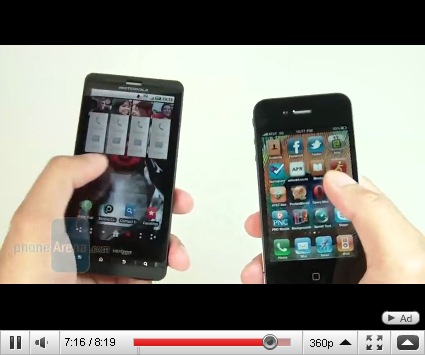
THE GAME Gear: Motorola DROID X vs. Apple iPhone 4
PhoneArena presents a thorough video comparison of the new Motorola DROID X and Apple’s hot iPhone 4. For a comprehensive comparison and analysis of the hardware and the performance of the DROID X and iPhone 4 go here.
Subscribe to:
Posts (Atom)


